
All Services›Video Podcasts
Video podcast production built to grow your audience.
Full-service video podcast production: strategy, pre-production, studio access, LED wall, full crew, editing, clips, and show notes. One rate that covers everything. Studio fees included.
20–60 min
typical length
1–2 wks
per episode
$1,500+
starting at

LOOK Studios
Phoenix-based. National reach. One permanent crew on every project.
Use Case
A video podcast
is essential when.
You're building thought leadership and want content that earns sustained, long-term attention.
Your team has expertise worth sharing: interviews, panels, or founder commentary.
You want to turn one shoot into clips for YouTube, LinkedIn, Spotify, Apple Podcasts, and beyond.
Your competitors are running audio-only shows and you want a production edge.
You need a recurring content engine that builds audience and authority every week.
Our Work
Recent projects.
Deliverables
What's included
in every engagement.
Content planning & strategy
Episode format, topic roadmap, guest or co-host structure, and distribution strategy defined before we touch a camera.
Pre-production
Run of show, visual treatment, lighting and camera design, and a brand kit locked before recording day. No surprises on set.
Studio access, included
Full use of our Chandler studio, 16 ft LED wall, and additional production support are included in the episode rate. No separate studio charge.
Full episode edit
Color grade, audio mix, pacing edit, intro/outro, and motion graphic overlays. Delivered in widescreen for YouTube and vertical for shorts.
Short-form clip package
3–5 platform-optimized clips cut from each episode, ready for LinkedIn, Instagram Reels, YouTube Shorts, and TikTok.
Transcript & show notes
Episode transcript and SEO-ready show notes delivered with every episode for distribution and discoverability. Captions matter for more than compliance: they're essential for accessibility and they measurably boost social media engagement, which is part of why a transcript ships with every episode by default.

Your options
Full production or
just the studio.
We offer two completely separate ways to produce your podcast at LOOK Studios. Full-service production and studio rental are independent options, you can use either one on its own, or combine them as your workflow grows.
Option 01
Full-Service Production
We handle everything, strategy, pre-production, recording, editing, clips, and show notes. You show up and host. Studio access and LED wall are included in the episode rate.
- Content planning & episode strategy
- Pre-production: format, guests, run of show
- Studio access, included, not additional
- 16 ft LED wall included
- Full production crew on-site
- Camera operator included
- Full episode edit + color + audio mix
- 3–5 short-form clips per episode
- Transcript + SEO show notes
Starting at $1,500 / episode · Studio fees included
Option 02
Rent the studio, DIY
Rent the studio by the hour and bring your own crew, editing, and workflow. Two tiers depending on whether you need the LED wall. No strategy, no editing, no production team from our side, just the space.
Basic Space Rental
Cameras not included
$125 / hr
- Studio tech on-site
- Basic lighting + backdrops
- Multiple shooting locations
- Bring your own cameras + crew
- 2 hr minimum
Camera + LED Package
Cameras included
$200 / hr
- 2× Sony A9iii cameras + operator
- 16 ft LED screen
- Everything in Basic Space Rental
- Raw footage same-day
- 2 hr minimum
Hourly rate only. No crew, no editing, no strategy from our side.
Studio fees are included in full-service pricing. If you book full-service podcast production, there is no separate studio charge, one rate covers everything from planning through delivery.

Studio rental only
Just need a rentable studio — without full production support?
See podcast studio rental
How It Works
From brief
to delivery.

Video Podcasts · Step 01
Format discovery

Video Podcasts · Step 02
Studio design & setup
Video Podcasts · Step 03
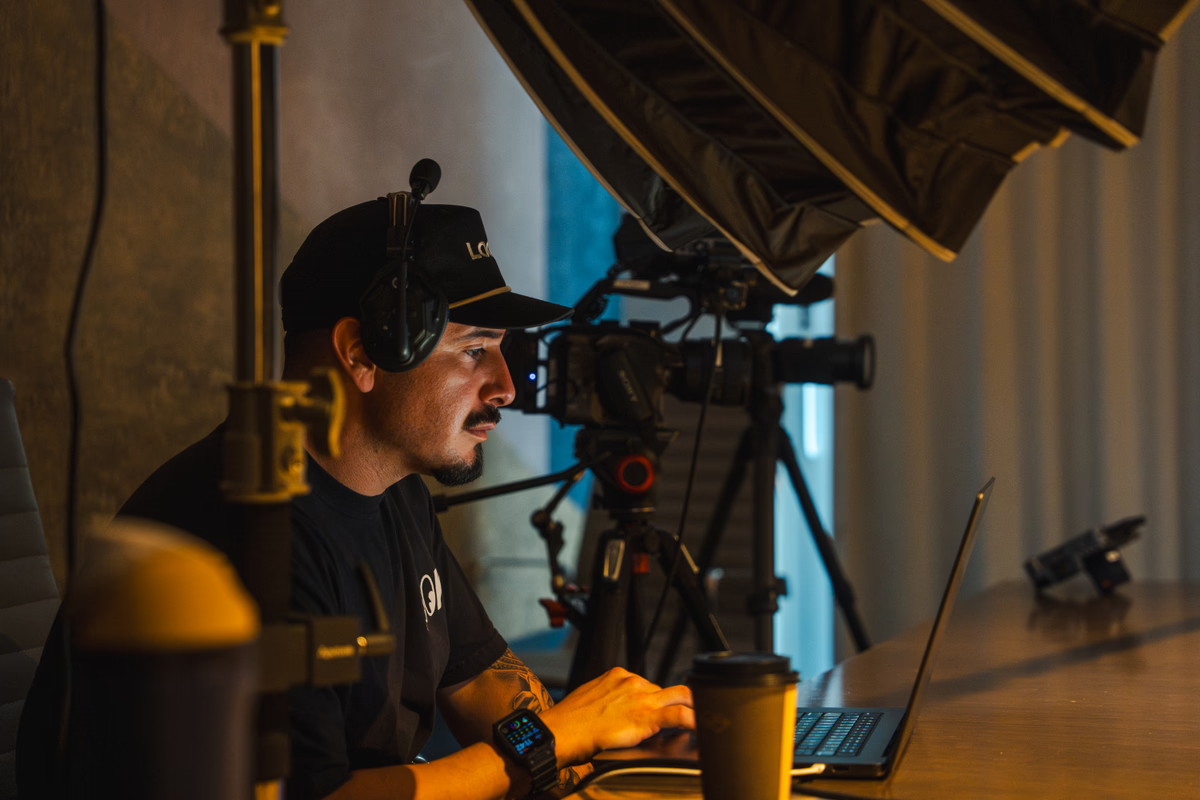
Recording day

Video Podcasts · Step 04
Post & distribution package
Add dedicated photography to any video podcasts shoot.
Behind-the-scenes stills and magazine-quality photography, delivered alongside your video for an additional fee.
Investment
Ready to start
your project?
Most video podcasts projects start at $1,500+. Exact cost depends on scope, location, and deliverable count.

Video Podcasts
Questions about video podcasts.
Yes. Studio fees are included in our full-service podcast production pricing: there is no separate studio charge on top of the episode rate. One rate covers everything from planning through delivery.
Full-service means we handle everything: strategy, pre-production, recording, editing, clips, and show notes. Studio rental is the space only: you bring your own crew, run your own cameras, and handle your own post. They are completely separate offerings and can be used independently.
Yes. Our studio rental starts at $125/hr for the space with basic gear, or $200/hr with the 16 ft LED wall and a camera operator. No production team, no editing: just the studio. See the podcast studio rental page for full details.
Typically 1–2 full episodes per shoot day depending on format and guest count. We batch-record to keep per-episode costs efficient, and every episode is delivered in a format ready for Apple Podcasts, Spotify, and YouTube alongside the video cut.
Yes. We can record in-person, remote, or hybrid setups and match the production quality across formats. Remote guests join through a simple video call on their end; we handle the technical setup on ours, though we'll usually ask them to hit record on a local audio backup too, just as insurance.
Audio quality matters more on a video podcast than the video itself: a viewer forgives a slightly soft shot far more easily than bad audio. Every recording uses professional audio gear, with a dedicated mic for each speaker and a real audio mix done in post rather than relying on camera-mounted microphones. That's true whether the episode uses a single camera or a full multi-camera setup: audio and video are treated as equally important, not audio as an afterthought to video, and it's true across whichever video format the episode ends up published in.
Yes. Most video podcast episodes are shot with multiple cameras covering different camera angles, so the edit can cut between hosts and guests the way a broadcast show would, instead of staying locked on one static angle for forty minutes. A single-camera setup works fine for smaller or more intimate formats, but a multi-camera setup is the standard for anything meant to hold a video audience's attention. Our podcast studio is built with multiple fixed camera positions for exactly this reason.
Every episode is delivered as a finished final product, not raw files you have to edit yourselves: the full episode edit, short-form clips, a transcript, and show notes. If you specifically want the raw material alongside the finished cut, we can include that in scope, but it's not what most clients need once the final delivery already covers what you need to publish. We can also design episode cover art as part of the deliverable package if you don't already have branded artwork.
Post-production covers the full episode edit: pacing, a real audio mix, color correction for consistent video quality across every camera angle, intro and outro graphics, and export in both widescreen for YouTube and vertical for shorts. Video editing on a podcast is different from a scripted brand video, since the edit has to follow a real conversation rather than a storyboard, but the same video editors handle both, and the same audio and video quality standards apply either way.
Every episode produces a short-form clip package of 3 to 5 platform-ready cuts: short clips and social clips built for LinkedIn, Instagram Reels, YouTube Shorts, and TikTok, pulled from the best moments in the full recording. That podcast content and video content works alongside the full episode, not instead of it, giving you a full show plus a week or two of social clips from a single recording day. YouTube in particular is the single biggest discovery platform for podcasts today, which is part of why the full episode is always exported in a YouTube-ready widescreen cut, not just a vertical one.
The difference is almost entirely visual design and lighting: a real backdrop or LED wall, proper camera height and angles, and a lighting setup built for video, not whatever a laptop webcam happens to catch. That's what separates a professional video podcast from an audio-only show someone points a camera at. High quality video comes from the setup, not the software, which is why studio access and camera equipment are included rather than left for clients to improvise.
An audio-only podcast is built to be heard; a video podcast is built to be watched and heard, with clips designed for platforms that are entirely visual, like Instagram Reels and YouTube Shorts. Audio podcasts and audio only podcasts can still work well, but video podcasting captures an entire second distribution channel audio alone can't reach. That's exactly why competitors running audio-only shows are increasingly adding a video layer to stay competitive. Video podcasts don't have to mean a full in-studio interview either: the format can range from a full studio recording down to a simpler setup built around static graphics or on-screen text, so there's a version that fits almost any budget before it ever reaches full production.
We'd rather point to our own numbers than a recycled industry stat. Our vertical film series for Arzuman Brothers drove 1.9M organic reach across Instagram and TikTok with a 4.7% engagement rate (nearly four times the 1.2% luxury real estate industry average) and 23 qualified leads directly attributed to the film series. A video podcast built with the same discipline (planned content, produced properly, distributed on purpose) compounds the same way.
Fast enough that treating video as an afterthought is a real opportunity cost. Spotify alone now hosts more than 250,000 video podcast shows, up from 100,000 the year before, according to Spotify's own 2024 platform announcement. Viewer preference is shifting too: Morning Consult's research found the share of U.S. adults who prefer podcasts with video grew from 32% to 42% between October 2022 and August 2024. Those are third-party numbers, not LOOK's own data, but they're the reason a video-first approach to your podcast compounds in a way a purely audio show doesn't.
Industry-wide, a professionally managed video podcast workflow typically runs 5–10 business days from recording to delivery, which lines up with our own stated 1–2 week turnaround per episode. Testing all equipment before recording, and budgeting real editing time (post-production commonly runs 3–5 hours of editing per hour of raw footage), is what keeps that timeline realistic instead of optimistic.
Our podcast production services cover the entire pipeline: content planning, pre-production, studio access with a full podcast studio setup, a production crew, the full episode edit, short-form clips, and show notes. Podcast production services and studio rental are two separate offerings (the podcast studio itself is one part of that, alongside the crew and post-production support), so clients only pay for what they actually need. Podcast episodes delivered this way are ready to publish the same week, not weeks later.
A new video podcast typically takes six to eight weeks to launch industry-wide, once you factor in strategy, branding, and workflow setup done from scratch. Our own process front-loads that into a single format discovery and studio setup phase before the first recording day. After that, every episode ships in 1–2 weeks, the same rate stated at the top of this page. A new show doesn't have to wait two months to see its first published episode.
Basic equipment for a video podcast breaks down into three categories: camera, audio, and light. A dedicated webcam is fine for a casual show, but a DSLR camera or mirrorless camera captures noticeably better video quality once you're publishing on a regular schedule. For audio, an external microphone always beats a built-in laptop mic; a USB condenser microphone is the easiest entry point, and a dedicated XLR condenser microphone is the next step up. A simple ring light works for a single host, but proper lighting is what separates a show that looks shot from one that looks recorded on a webcam.
A polished episode almost always comes down to a handful of details: consistent audio levels between speakers so no one has to reach for the volume mid-conversation, camera framing tight enough to actually read facial expressions instead of two tiny figures in a wide shot, and multiple camera angles cut together instead of one static lock-off for forty-five minutes. Many podcasters get the sound quality right and stop there, but a professional studio also controls the visual side (background, lighting, and framing) consistently across every episode, not just the pilot. None of this requires visual effects or anything flashy; a successful video podcast usually wins on consistency, not production tricks.
Yes. Adding video to an existing audio show extends it onto podcast platforms and video platforms a pure audio feed can't reach on its own, like YouTube and Spotify's video tab, without requiring you to rebuild the show from scratch.
Ready to start?
Let's talk video.
Bring us a brief or start with a conversation. We'll give you honest scope, honest pricing, and a team you can count on.