
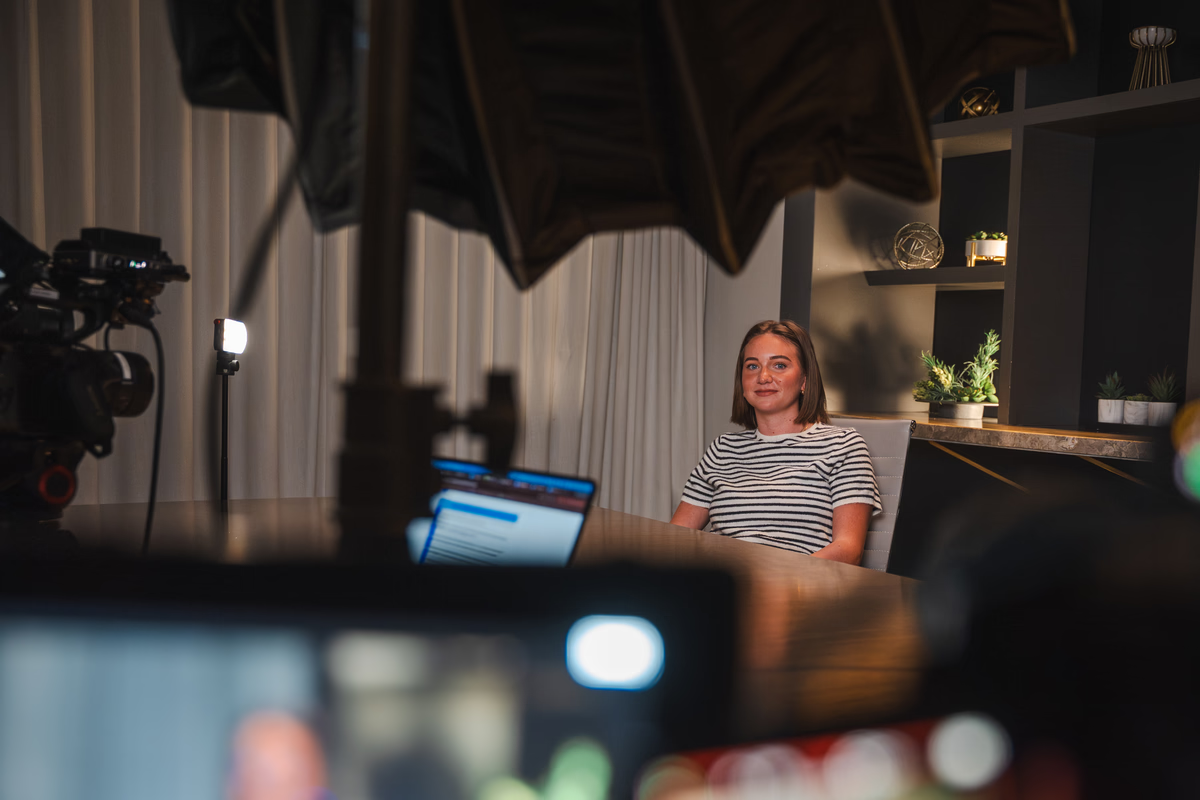
Testimonial video production costs $3,000–$20,000 depending on crew, location, number of subjects, and post-production scope. Here's what drives the price and what you get at each tier.
Testimonial video production typically costs between $3,000 and $20,000 per finished piece, depending on crew size, location, number of subjects, and post-production scope. Most single-subject testimonial shoots for B2B brands fall in the $4,000–$10,000 range. Multi-subject shoots with location travel, extended editing, and multiple deliverables push toward the higher end.
This guide breaks down what drives testimonial video cost, what you get at each price point, and how to brief a production company to get an accurate quote.
What Drives Testimonial Video Production Cost
Testimonial videos look straightforward, interview a customer, cut the best moments, add b-roll. In practice, the cost varies significantly based on five factors.
Crew Size
A professional testimonial shoot requires at minimum a director/DP, a camera operator, and an audio technician. That's a three-person crew. Some productions run with two, a DP who also directs, plus audio, but for broadcast-quality results, a dedicated director makes a meaningful difference in how the subject performs on camera.
More complex shoots — multiple cameras, dedicated lighting setups, a producer managing the client subject — run larger crews and higher day rates accordingly. Professional crew day rates range from $400 to $1,500 per person depending on role and market.
Location
Most testimonial shoots happen on location at the client's office or workplace. This is usually the right call — location context makes the subject more credible. On-location shoots require the crew to transport equipment, assess lighting conditions, and set up in an unfamiliar space, which adds time and complexity compared to a controlled studio environment.
Travel is billed separately when the subject is in a different city. A one-day shoot requiring flights and overnight accommodation for a two-person crew adds $1,500–$3,000 to the base production cost before any footage is shot.
Number of Subjects
A single-subject testimonial is the baseline. Each additional subject adds interview time, b-roll coverage for a new environment, and editing time for an additional story arc. Productions covering three to five customers in a single shoot day can spread the fixed setup cost across more deliverables — making per-video cost lower than producing each testimonial separately.
Post-Production Scope
A clean testimonial edit involves selecting the strongest soundbites, cutting b-roll coverage to support the narrative, adding lower thirds, and laying a licensed music bed. That's the baseline.
Additional post-production costs include: custom motion graphics or animated lower thirds ($500–$1,500), color grading beyond basic correction ($300–$800), closed captioning ($150–$400), and additional length variants — a :30 social cut from the same interview adds $300–$600 in editing time.
Revision Rounds
Most production companies build one to two rounds of revisions into the base quote. Additional rounds are billed at hourly editing rates, typically $75–$200/hr. Testimonials with multiple internal stakeholders who review separately — instead of consolidating feedback — tend to accumulate revision costs faster than projects with a single decision-maker.
Testimonial Video Cost by Tier
$3,000–$5,000, Lean Single-Subject Shoot
Two to three person crew. Single subject at their office. One camera, professional audio, natural or practitioner lighting. Edit includes soundbite selection, b-roll cuts, lower thirds, and music. One deliverable: a 1.5–3 minute finished testimonial. Turnaround: 2–3 weeks. This tier works well for B2B companies building an initial library of customer proof.
$5,000–$10,000, Full Single-Subject Production
Three to four person crew. Dedicated director separate from the DP. Full lighting package — not just available light. Multiple camera angles. B-roll coverage across two or more locations within the same facility. Professional color grade. Lower thirds and custom motion graphics. One hero testimonial plus a :30–:60 social cut. This is the most common range for mid-market B2B and professional services firms.
$10,000–$20,000, Multi-Subject or Multi-Location
Two to three subjects covered in one to two shoot days, or a single subject requiring location travel. Full crew, full post-production. Multiple finished testimonials plus social cut-downs. Some engagements in this range include a short case study cut alongside the testimonial — a two-minute story arc that covers the problem, solution, and outcome in more depth than a standard testimonial format.
Interview Structure and Why It Affects Cost
How the interview is structured determines how much editing time is required in post. An unstructured interview where the subject talks freely for 30–40 minutes produces a lot of footage — but requires significantly more time to find the story in the edit. A directed interview with a clear narrative arc (open with the outcome, walk back through the challenge and solution) produces tighter footage and faster edits.
Production companies that direct interviews as a core competency, rather than just filming what the subject says, deliver shorter edits, fewer revision rounds, and better final video quality for the same amount of camera time.
B-Roll: What It Is and Why It Matters
B-roll is the supplementary footage, workspaces, product shots, the client using the service, team interactions, that covers the interview audio when the edit needs to move away from the talking-head shot. Without b-roll, a testimonial is just a static interview. With b-roll, it becomes a visual story.
B-roll coverage adds shoot time and therefore cost. A standard testimonial shoot allocates 1–2 hours for b-roll after the interview. More complex productions — covering a manufacturing floor, a construction site, or a medical practice — require more time and logistical planning. The scope of b-roll coverage should be discussed explicitly in the brief, since it significantly affects the shoot day schedule.
Single Testimonial vs. Testimonial Series
Producing a single testimonial is the most common engagement. But companies with an ongoing proof-of-concept need get better economics from a series commitment. A production company that shoots three to five customer stories in a coordinated campaign — same crew, same workflow, overlapping shoot days — can typically produce each piece at 60–75% of the standalone cost.
Series production also creates consistency in visual style across all testimonials, which matters when they're being used in a sales environment where multiple videos appear side by side.
What Testimonial Videos Are Worth
According to Wyzowl's 2024 State of Video Marketing report, 79% of people say a brand's testimonial video has convinced them to buy a product or service. Customer video testimonials consistently outperform written case studies and review page screenshots in sales cycle performance, because they create a level of trust that text alone cannot.
The ROI calculation for testimonial video is clearer than most content investments: if a testimonial shortens a single enterprise sales cycle by two weeks, the revenue acceleration on that deal likely exceeds the cost of the video.
For a sense of where testimonial video fits in your production budget overall, the video production cost guide covers pricing across all major video types.
Video Testimonials vs. Written Testimonials
Written testimonials and star ratings still have a place in a sales funnel, but video testimonials operate differently. When a real customer appears on camera — speaking in their own voice, from their own environment — the social proof is substantially more credible than text pulled from an email or a Google review. Viewers can read the body language, hear the conviction in the voice, and see the person in context.
According to Wyzowl's 2024 State of Video Marketing report, 79% of consumers say watching a video testimonial has directly influenced a purchase decision. The equivalent figure for written testimonials is significantly lower. For high-consideration purchases — enterprise software, professional services, construction, healthcare — video testimonials are the strongest trust-building asset available.
The production cost of a video testimonial is the main barrier that keeps companies at the written testimonial stage. That gap closes quickly when one video testimonial closes a single deal that written content couldn't close.
Testimonial Video vs. Case Study Video
Testimonial videos and case study videos both use customer proof, but they serve different sales functions. A testimonial video captures a customer's experience in their own words, it's advocacy. A case study video tells the structured story of a specific engagement: the problem, the solution, and the measurable outcome. It's documentation.
Testimonials work best early in the sales funnel, when a prospect is deciding whether to trust the brand. Case study videos work best in mid-to-late funnel conversations, when the prospect needs to understand exactly how you solve a specific type of problem.
Production costs for case study videos run $6,500–$20,000, depending on scope. They typically require more pre-production structure — a narrative arc has to be developed from the engagement details — and more post-production to build the story properly. Many B2B brands produce both: a two-minute testimonial for top-of-funnel use and a four-minute case study cut for the sales deck.
Choosing a Video Production Company for Testimonials
Not every video production company is equally suited for testimonial work. Testimonial production requires a specific skill set: the ability to direct non-actors, conduct a live interview that surfaces compelling soundbites, and manage the interpersonal dynamics of putting a real customer in front of a camera.
When evaluating a video production company for customer testimonial video, ask to see their testimonial reel specifically — not just their general work. A company that shoots narrative commercials beautifully may not have the interviewing ability to direct an unscripted customer effectively. Look for companies whose testimonial samples feel natural, not coached.
Key questions to ask: Do you write interview questions or do we provide them? How do you prep subjects before the shoot? How do you handle a subject who freezes or gives short answers on camera? The answers reveal whether testimonial production is a core competency or an occasional add-on.
Using Testimonial Video in Your Marketing Strategy
A finished testimonial video is a versatile marketing asset. The full-length piece (90 seconds to 3 minutes) lives on the website, in sales decks, and in email sequences. :30 and :15 cuts run as paid social ads on LinkedIn and Meta. Still frames from the interview serve as social posts. Quotes from the transcript appear in sales materials and proposals.
Video content from testimonials performs particularly well in LinkedIn outreach when a sales rep can send a prospect a short clip of a customer from the same industry or role. A message paired with a relevant 30-second testimonial clip converts at a measurably higher rate than text-only outreach, because it provides social proof at the exact moment the prospect is evaluating the brand.
For brands with longer sales cycles, a library of customer testimonial videos — covering different industries, use cases, and company sizes — gives sales reps the ability to match proof to prospect. A prospect in healthcare sees a healthcare testimonial. A prospect at an enterprise company sees a testimonial from a comparable brand. The specificity of the match matters.
How to Brief a Testimonial Video Production
A good brief for a testimonial shoot answers five questions: Who is the subject, and what is their relationship with your company? What is the primary outcome or result you want the testimonial to communicate? Where will the video be used — sales deck, website, paid ads? What is the target length? And is there a visual style reference that represents what you're aiming for?
The more specific the brief, the more targeted the interview questions and the more efficient the edit. A brief that says 'we want a testimonial from our client about how we helped them' produces a generic video. A brief that says 'we want a 2-minute testimonial from our client, a regional medical group, about how we helped them reduce staff onboarding time by 40%, for use in our sales deck for other healthcare buyers' produces a targeted, useful asset.
Pre-Production for Testimonial Video
Pre-production for a testimonial shoot involves three main activities: subject preparation, location assessment, and question development. Subject preparation is the most important — a customer who arrives knowing what story they're telling and what moments they want to highlight produces a better interview with fewer restarts and better soundbites.
Most professional production companies send clients a prep guide 48–72 hours before the shoot. The prep guide explains what to wear (solid colors, avoid patterns that strobe on camera), what to expect on set, and — most importantly — asks the subject to think through three to five moments or outcomes they want to reference in the interview. A prepared subject requires 20–40 minutes of interview time to get the footage needed. An unprepared subject can take twice as long.
Location assessment is part of pre-production for on-location testimonial shoots. The crew needs to evaluate ambient light, background suitability, acoustic properties of the space, and power access for lighting equipment. This is typically done via a quick video call walkthrough or on-site scout visit the day before the shoot.
Post-Production: How a Testimonial Edit Is Built
The post-production process for a testimonial video follows a defined sequence: logging, rough cut, fine cut, color grade, sound design and music, graphics, and export. For a standard single-subject testimonial, this process takes 8–20 hours of editor time depending on the length of the raw footage and the complexity of the deliverable.
Logging is the first step — reviewing all the footage and marking the best soundbites, the strongest b-roll shots, and identifying any technical issues that need to be worked around (an airplane heard in the background, a lighting change mid-interview). A good logging process saves editing time by giving the editor a map of the footage before the timeline is built.
Color grading and sound design are often underweighted in budget conversations. Proper color grading corrects for the actual lighting conditions on set and gives the footage a consistent, professional look. Sound design adds subtle room tone consistency, removes distracting background noise, and gives the music bed proper balance with the voice. The difference between a graded, sound-designed cut and a raw timeline edit is significant, it's the difference between video that looks produced and video that looks like a home recording.
Building a Testimonial Video Budget
A well-structured testimonial video production budget has four line items: pre-production, production (shoot day), post-production, and deliverables. The common mistake is budgeting only for the shoot day and being surprised by pre-production and post-production costs.
A realistic budget breakdown for a mid-range testimonial ($6,000–$8,000 total) looks like this: pre-production coordination and prep — $500–$800; shoot day crew and equipment — $2,500–$3,500; post-production editing, color, sound, and music licensing — $2,000–$3,000; delivery in multiple formats — $200–$500. These are not arbitrary allocations — they reflect the actual labor and cost at each stage.
Music licensing is a separate line item that catches clients by surprise. Licensed music tracks for commercial video use run $200–$800 per track depending on the licensing platform and usage rights. Production music libraries (Artlist, Musicbed, Epidemic Sound) offer annual subscriptions that reduce per-track cost for companies with ongoing production needs.
Common Mistakes in Testimonial Video Production
The most common mistake is producing a testimonial without a clear narrative goal. A testimonial that tries to communicate everything about the relationship produces a video that communicates nothing clearly. Before briefing the production company, identify the single most important message the testimonial should leave with a viewer — and let that govern which soundbites are used in the edit.
The second most common mistake is skipping the prep call with the subject. Without preparation, subjects often default to formal, corporate language on camera — the opposite of the authentic, conversational tone that makes testimonials persuasive. A 15-minute prep call changes the outcome of the interview significantly.
A third mistake is approving the first cut without watching the full video in context. Testimonial approvals often happen with executives reviewing specific soundbites rather than watching the complete video as a viewer would. Watch the full cut in a context that mirrors how it will be seen — on a laptop screen, in a sales meeting context — before finalizing the edit.
About the Author

Hayden Sage
CEO & Executive Producer